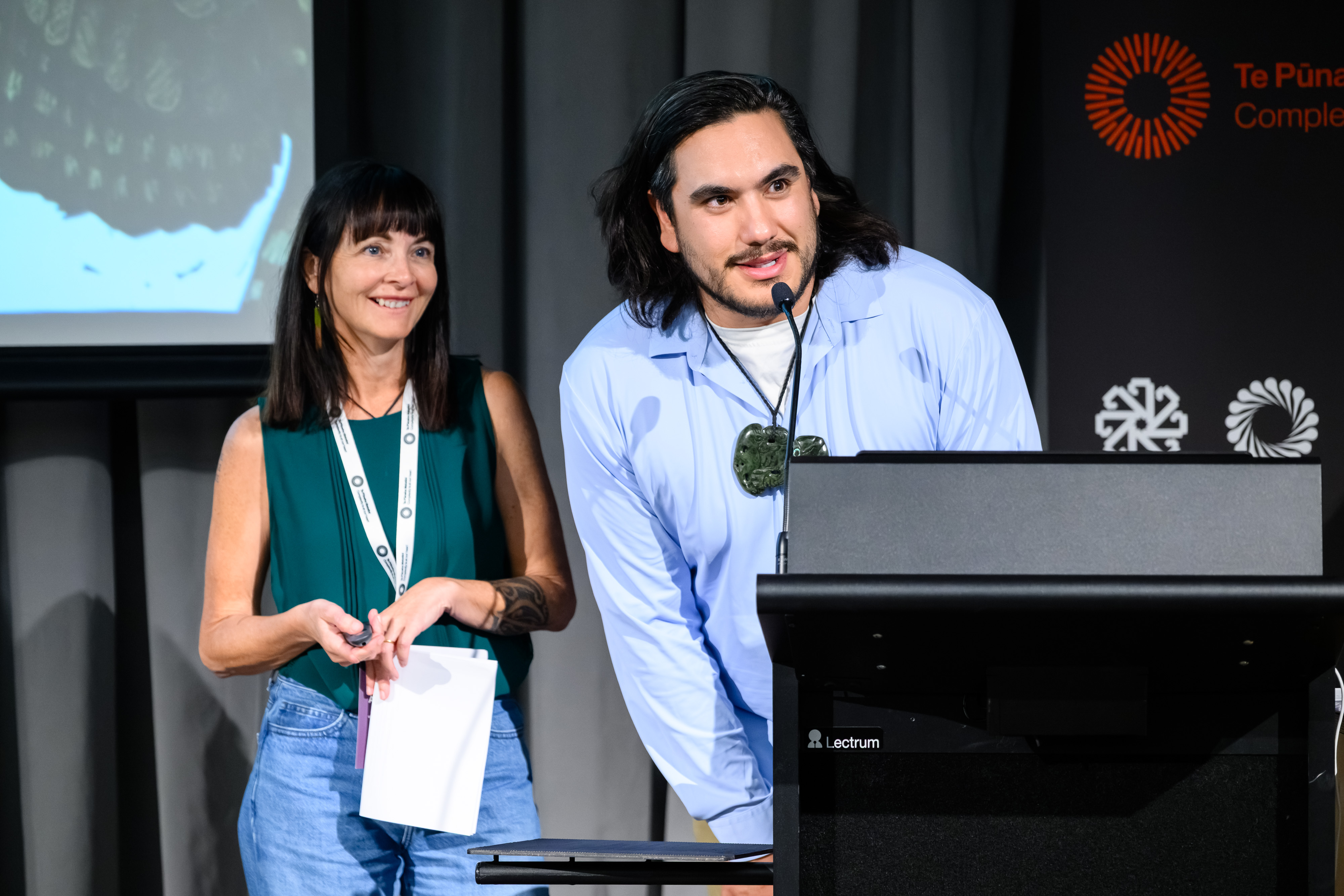

At the recent Capital City Complex Systems Symposium (CCCSS 2026), hosted at the National Library in Te Whanganui a Tara by Te Pūnaha Matatini the Kia Puāwai TUI team (Translation, Uptake and Impact) was proud to share how Indigenous-led research can shape the way complex systems are understood, navigated, and changed.
Kia Puāwai researchers Tom Johnson and Dr Tanya Allport delivered a keynote presentation titled When Te Ruru calls, the system must listen: Seeing the unseen in complex systems. The keynote introduced Te Ruru, an Indigenous systems change framework grounded in whakapapa, relational responsibility, and lived practice. Rather than offering a single model or solution, Te Ruru invited symposium participants to consider complexity within the context of Indigenous thinking and to recognise Indigenous knowledge as foundational to systems thinking, not an add-on.
Alongside the keynote, a range of research outputs developed across the Kia Puāwai programme was showcased. This included work from He Waka Eke Noa, Rapua Te Ara Rangatira, TUI, and Tō mātou kāinga, tō mātou ūkaipō. These projects demonstrate how kaupapa Māori research can move beyond reports and frameworks to produce practical, creative, and relational tools that support whānau, leaders, and organisations to act.
Sharing these outputs in a complex systems forum was intentional, for Kia Puāwai research is not designed to sit on shelves. It is designed to be used, tested, adapted, and lived. CCCSS brought together systems thinkers from diverse disciplines, providing an important space to show how Indigenous-led approaches already do the work that many systems frameworks aspire to: holding complexity, centring relationships, and working across long time horizons.
The strong interest and kōrero that followed the keynote reaffirmed the value of this mahi. Kia Puāwai will continue to develop, refine, and share research outputs that support systems change while remaining grounded in tikanga, care, and responsibility to whānau and whenua.
Learn more about Te Pūnaha Matatini here: https://www.tepunahamatatini.ac.nz/
Photographer Mark Coote