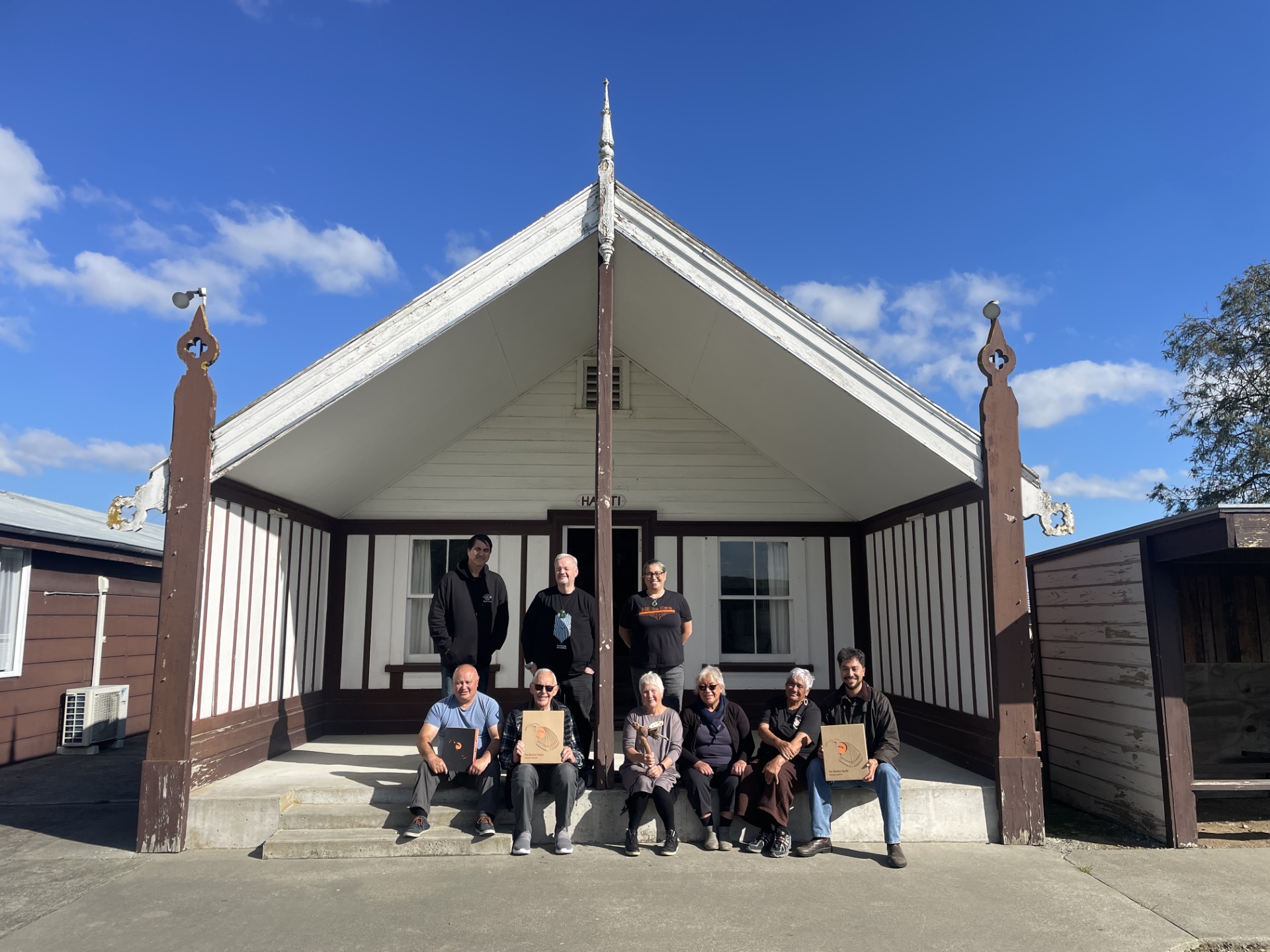

Te Remu Huia Handbook has been presented to Te Rūnanga o Ngāti Hauiti, after three years of research carried out alongside the Rapua project team. The presentation took place at the Hui Rautaki, the Rūnanga’s quarterly strategy meeting, held early in May, 2026, at the Rātā Marae.
Te Remu Huia is a bespoke governance and leadership model designed specifically for Te Rūnanga o Ngāti Hauiti. The model draws on the symbolism of the huia bird, whose remu, or tail feathers, were worn by rangatira and ariki. The remu are therefore an expression of tino rangatiratanga, the central concept of the model.
Leading into the presentation of Te Remu Huia Handbook, the Rapua team walked the Rūnanga delegates through the full body of research, from the initial interviews to the final presentation of the handbook. During the hui, Utiku Potaka reflected on two earlier publications: Interim Findings (2023) which presents a thematic analysis of interviews with leaders and governors from Ngāti Hauiti, Mōkai Pātea-nui-tonu, and Te Ranga Tupua, and the Ngāti Hauiti Leadership Timeline (2024) which records significant moments in Ngāti Hauiti leadership over the past 200 years.
Amohia Boulton then introduced the latest publication: Voices of Emerging Leaders (2026). Following the initial group of interviews used in the Interim Findings analysis, the Rapua team realised there was a critical gap in the research, a lack of a rangatahi voice. Therefore, a Ngāti Hauiti rangatahi was engaged to interview a small group of rangatahi, gathering their whakaaro on key themes that were centered on whakataukī and whakatauākī.
The team also reflected on the Te Remu Huia Workbook, which was used to create the model and throughout 2024 and 2025. Photographs from wānanga with the Rūnanga were shared, as were early brainstorms from the Rapua team, showing how the huia connects to rangatiratanga and the values of the Rūnanga. Te Remu Huia Handbook (2026) represents a culmination of that body of work.

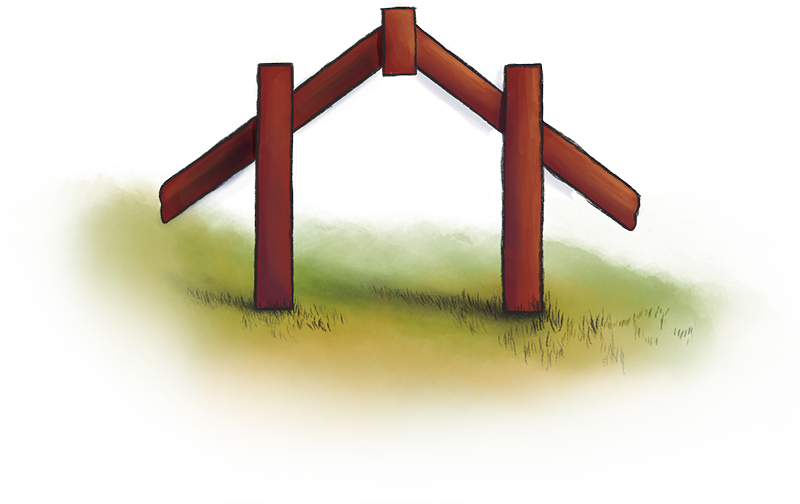
The Handbook features a new tohu designed by Maihi Potaka-Butler (Ngāti Hauiti) and a tabulated book design for ease of reference created by Chris Anderson (Ngāti Rangitihi), a summer design student on the project. The combined publications are brought together in Te Waka Remu Huia, a package named after the waka huia, a carved treasure box used to store huia feathers and other taonga which was also designed by Chris.

Overall, the Rūnanga were impressed with how their whakaaro was represented across the materials. For Pania Winiata (Manu Taki for Ngāi Te Ngāhoa), seeing the tohu with its bright orange contrast “touched my heart”. Brigham Anderson (Manu Taki for Ngāti Tamatereka) said the model represents a process of “decolonisation-ing”, one that challenges the way governance is practiced compared to what he sees in the public sector. Barbara Thomason (Manu Taki for Ngāti Hinemanu) described Te Waka Remu Huia as a “taonga” that she hopes to one day pass to her mokopuna, as a record of her mahi for the Rūnanga and an invitation for them to take up iwi leadership and governance roles.
The Handbook made an immediate impact as it was referenced later on during the Hui Rautaki to clarify processes of a particular kaupapa. Te Remu Huia Handbook now sits with the Rūnanga and will play a critical role in the Rūnanga’s governance, leadership and decision making, and for inducting future Manu Taki into Te Whirikōkō, the group of hapū delegates.